When the Model Gets Recalled
2026-06-12
By Terrell A. Lancaster · AI & Cloud Solutions Architect · June 2026
One of my agents went quiet on a Friday evening. Not a crash, not a hang — quiet. A message I'd sent it was sitting unread in its queue, and the thing that runs twenty-four hours a day, trades, ships code, and answers me had simply stopped having anything to say. I've debugged a lot of agent failures. This one was new. The agent was fine. The model underneath it had been pulled out from under it by the federal government, mid-sentence.
What actually happened
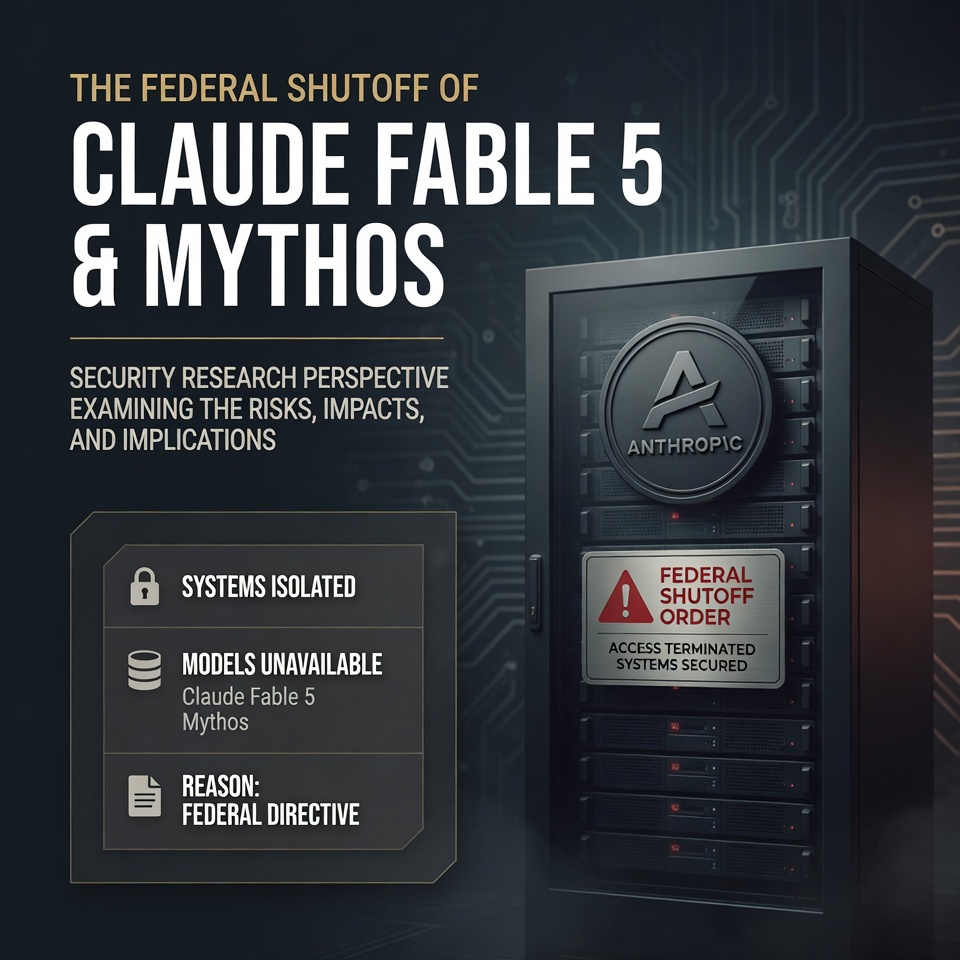
On June 12, 2026, at 5:21pm ET, Anthropic received a US government export-control directive, citing national-security authorities, ordering it to suspend all access to its two most capable models — Claude Fable 5 and Claude Mythos 5 — for any foreign national, inside or outside the United States, including Anthropic's own foreign-national employees.
There is no clean way to enforce "foreign nationals only" against a live user base in real time. So the only way to comply was the blunt one: disable both models worldwide, for every customer. Every other Anthropic model kept running. These two went dark. They had launched three days earlier, on June 9.
Anthropic complied, and then — unusually — said publicly that it disagreed. In its own statement it wrote that it "disagree[s] that the finding of a narrow potential jailbreak should be cause for recalling a commercial model deployed to hundreds of millions of people," and warned that if the same standard were applied across the industry, it would "essentially halt all new model deployments for all frontier model providers." It apologized to customers and said it is working to restore access. The reported trigger, per Axios, was another company's claim that it could jailbreak Mythos; Anthropic characterized the government's evidence as verbal only, and the "jailbreak" as little more than asking the model to read a codebase and point out a handful of minor, already-known flaws — the kind of thing, it noted, other public models do without any bypass.
I'm going to be careful with the superlatives, because the reporting is. NBC called it what appears to be the first time a leading AI company has taken a publicly deployed model offline because of federal intervention; the AP dialed that back to the government's "most significant step to date." No primary government document is public — the government-side details rest on press reporting. So set the "first ever" question aside. The fact that survives all of the hedging is the one that matters to me as a builder: a federal action reached into a live, commercially deployed frontier model and forced it dark, globally, within hours.
The part nobody's writing about
Everyone's covering the politics. Here's the downstream, from inside a system that depended on one of those models.
My agent was running on Fable 5 — the large-context variant — and the model identity was pinned the lazy way almost everyone pins it: implicitly, through the tool's cached last-selected model. No explicit model in config. No fallback. When Fable 5 was disabled, the next turn the agent tried to take came back with There's an issue with the selected model (claude-fable-5). It may not exist or you may not have access to it. And then nothing. It did not fall back to another model. It did not raise an alarm. It just stopped, with my message unread, and waited for a human to notice it was dead.
When I dug in, the diagnosis was almost funny. The session was healthy. The message daemon was healthy. The queue, the process supervisor, the network — all healthy. The only broken component in the entire stack was the model SKU, and the tool was still cheerfully pointing at it next to the vendor's own "this model is unavailable" notice. The fix was one line — repoint to Opus 4.8 and save it as the durable default, which healed the live agent and every future restart at once. The fix was trivial. The failure mode is not.
Model-supply-chain risk, sovereign edition
I've written before that one of the failure classes I watch in autonomous systems is model-supply-chain compromise. I was thinking about poisoned weights and vendor sunsets. I wasn't thinking about a cabinet secretary. But it's the same dependency from the agent's point of view: an always-on agentic system carries a hard, hidden dependency on one specific model SKU, and when that SKU disappears — by deprecation, by a rate limit, or now, for the first time I've seen in the wild, by a government order — the agent doesn't degrade gracefully. It dies. And in most hand-built stacks, it dies silently.
That last word is the whole problem. A silent failure in a system with real authority is worse than a loud one. The agent that went quiet on me could just as easily have been the one watching a position, or holding a customer conversation, or gating a deploy. The disruptor this time wasn't an attacker and wasn't a vendor cleaning up its model list. It was a sovereign regulator, and that is a line item missing from almost every threat model I see.
What I'd build differently
Four controls, and none of them are exotic:
Pin an explicit model with a documented fallback ladder. Never inherit your model from a cached UI selection. Name the model you want, name the one you fall to, and make the fall automatic.
Monitor for model-availability errors and alarm on them. "The model returned an error that it does not exist" should page someone. Do not let "a human eventually noticed the silence" be your detection control.
Design agents to fail loud and fail over, not fail silent. A degraded answer from a backup model, with a flag, beats a perfect answer that never comes.
Treat "which model am I" as configuration under change control. The SKU underneath you is no longer guaranteed to exist tomorrow. Version it, monitor it, and have a tested path off it.
The capability of these models is racing ahead of the operational discipline around them. June 12 was a reminder that the assumptions underneath an always-on agent — that the model will be there, that it's your vendor's decision and yours when it goes away — are softer than they look. If you're running anything autonomous on a frontier model, ask the boring question before the next directive, deprecation, or outage asks it for you: when the model under your agent disappears, does your agent tell you — or does it just go quiet?